Browsed by
Author: Nara V

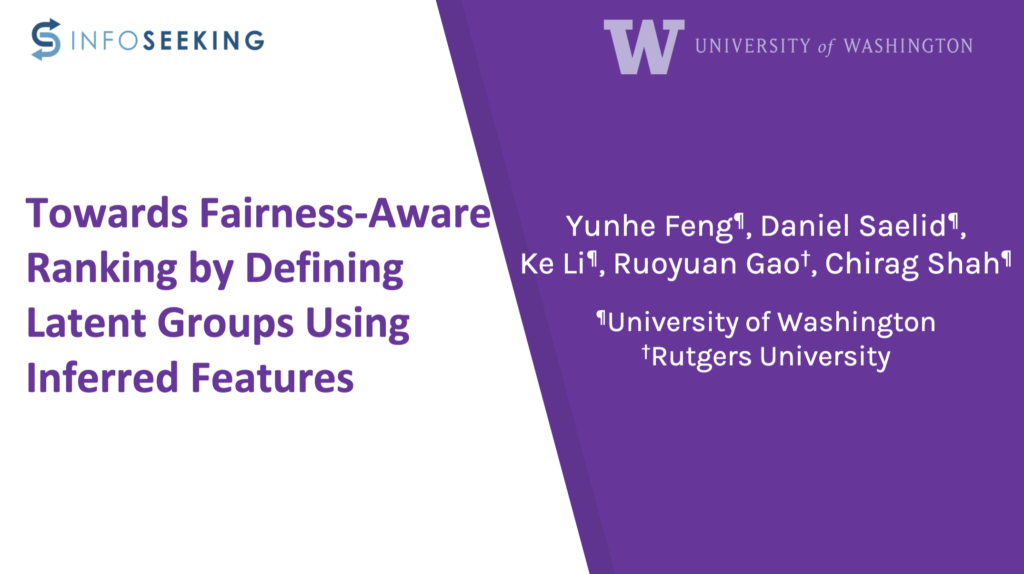
Taking a step towards fairness-aware ranking by defining latent groups using inferred features.

Taking a step towards fairness-aware ranking by defining latent groups using inferred features.

At the BIAS @ ECIR 2021 Workshop, our lab members continue to investigate the importance of fairness in search and recommendation that is increasingly drawing attention in recent years.

The paper explores how to define latent groups, which cannot be determined by self-contained features but must be inferred from external data sources, for fairness-aware ranking. In particular, taking the Semantic Scholar dataset released in TREC 2020 Fairness Ranking Track as a case study, we infer and extract multiple fairness-related dimensions of author identity including gender and location to construct groups.

Results

We propose a fairness-aware re-ranking algorithm incorporating both weighted relevance and diversity of returned items for given queries. Our experimental results demonstrate that different combinations of relative weights assigned to relevance, gender, and location groups perform as expected.

Future work

Due to inaccurate group classifications, for our future work, we propose to explore public personal locations, such as using Twitter profile locations.

Interested to learn more?

Read the full research paper here or watch the full presentation.
Lab members participated in the CHIIR 2021 Virtual Conference

Lab members participated in the CHIIR 2021 Virtual Conference

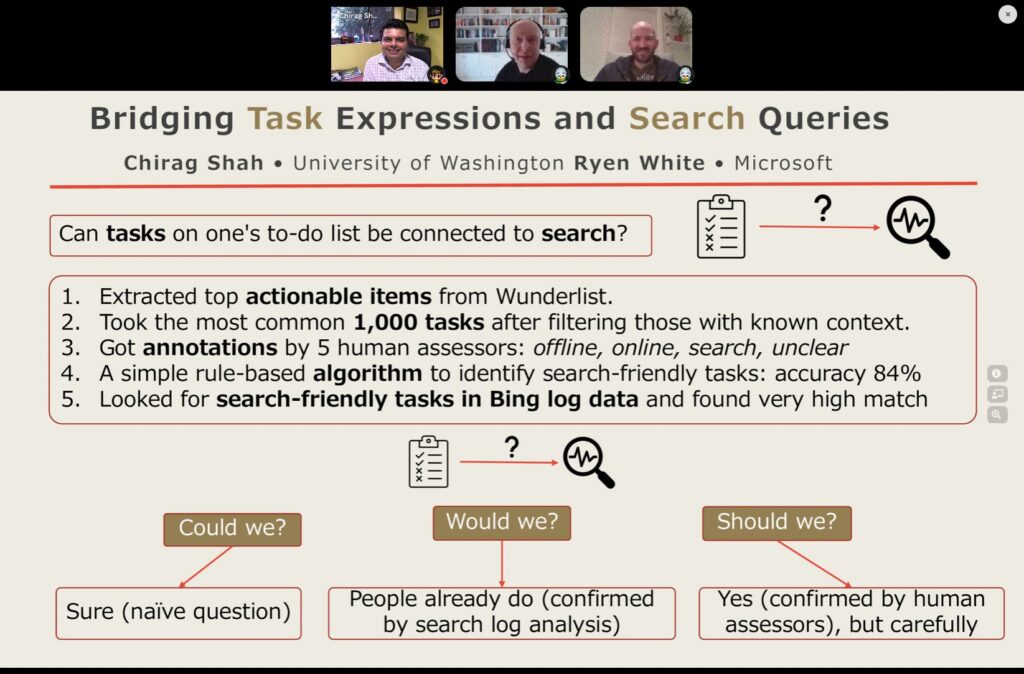
Several of the lab members participated in the ACM SIGIR Conference on Human Information Interaction and Retrieval (CHIIR) 2021 last week. CHIIR focuses on elements such as human involvement in search activities, and information seeking and use in context. Our lab director Dr. Shah is the Chair of the CHIIR Steering Committee. He presented a paper that was in collaboration with Microsoft Research (MSR) AI.

Several InfoSeeking students were also working as volunteers for the conference. “It was helpful to get feedback and questions from expert mentors in the field. As always, it was fun to be at CHIIR and seize opportunities to meet friends and colleagues. I had some productive discussions in front of the aquarium in the lobby at Gather Town”. Shawon Sarker PhD Student @ InfoSeeking Lab presented her dissertation “A context-independent representation of task” that aims to explicate task information from user behaviors and apply task knowledge to search and recommendations in order to support users to complete their tasks, especially complex tasks, across multiple devices.

For more information about CHIIR visit: https://acm-chiir.github.io/chiir2021/

iSchool’s unique approach to teaching data science by focusing on human values, transparency privacy and fairness

iSchool’s unique approach to teaching data science by focusing on human values, transparency privacy and fairness


When people talk about data science programs, what do you think of? Artificial intelligence, machine learning, or coding is probably the most popular answer for those outside the discipline. What if we told you there is more to that than what meets the eye. At iSchool, we continue to empower students in understanding the implications of using such a powerful tool. With our unique approach, we have designed a program that incorporates data science through a human-centered lens, promoting solutions that are socially responsible and understanding where the potential solutions get implemented. We strive to embody students to focus on human values such as privacy, human rights, and ethics while working on data problems. This means asking not just what technology could do, but also what it should do. And this means acknowledging and addressing the individuals, organizations, and communities behind the production and consumption of data and technology. At iSchool, a small group of iSchool faculty- the iSchool Data Science Curriculum Committee (iDSCC) continues to create a more cohesive and comprehensive program. In doing so, the iSchools are paving a path for DS that can create informative, insightful, and impactful solutions for the whole of humanity for generations to come. We believe foregrounding human needs and business understanding in this way not only will lead to more ethical data science practices but also a more successful (and profitable) outcome.

Our lab director Dr. Shah wrote an article with his international collaborators on what it is to do and teach data science in an iSchool.

Shah, C., Anderson, T., Hagen, L., & Zhang, Y. An iSchool approach to data science: Human-centered, socially responsible, and context-driven. Journal of the Association for Information Science and Technology (JASIST).

Read the full article here.