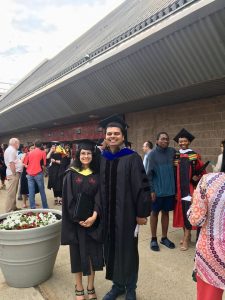
In September we had two InfoSkeeing Lab successfully defend their dissertations!
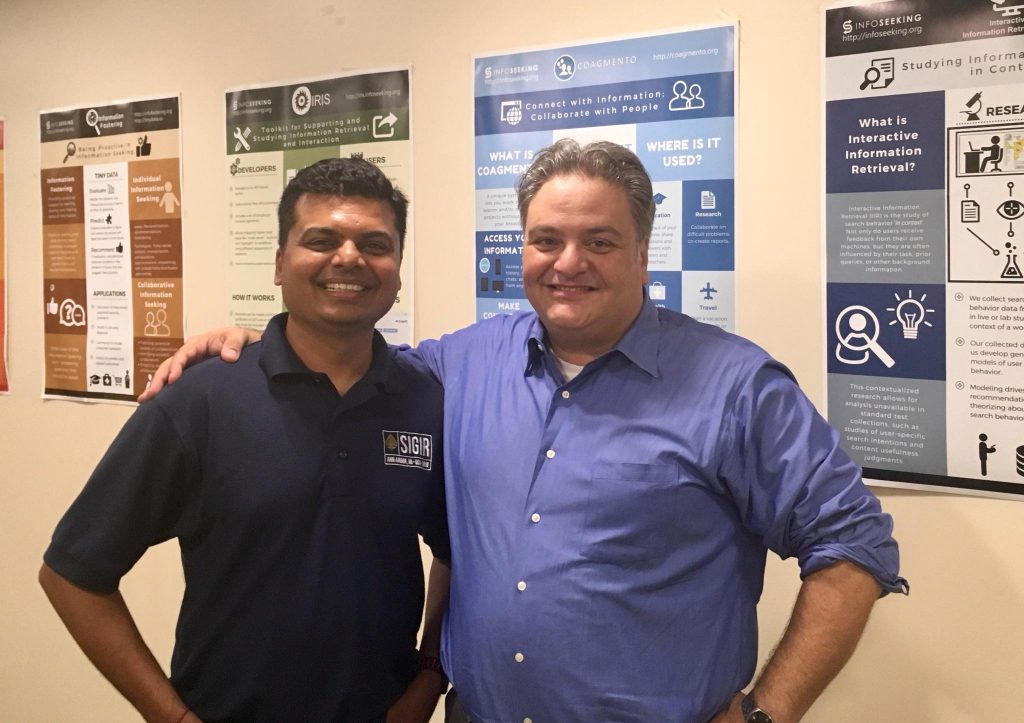
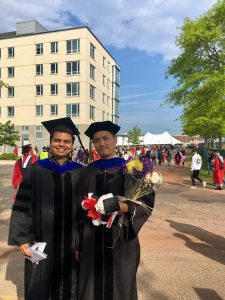
On September 7th, our very own Zaid Matni successfully defended his dissertation, “The Influence of Network Structures and Information Seeking Uncertainty on Information Seeking Behavior” in front of a demanding panel of fellow scholars, marking our 6th PhD Graduate of the lab.
Zaid Matni, right, after defending his dissertation, with Professor Chirag Shah.
Zaid’s dissertation explores quantifiable behavioral dynamics of individuals who are seeking information using different social network structures over time. His study utilized a custom-built Web-based tool that simulates an information-seeking scenario via various network structures and had participants utilize it to achieve a stated goal of collecting answers to questions from others in their network. The tool allows a finite amount of interactions, thus limiting the participants’ engagements to a defined set of allowable actions. His dissertation contributed to the theories of information seeking in social network environments, as well as to social network theory as it pertains to human information behavior. Additionally, it served as another method to study human behavior through the lens of social networks by providing them with a sophisticated computer-mediated platform to collect log-based data of human behavior in simulated networked environments.
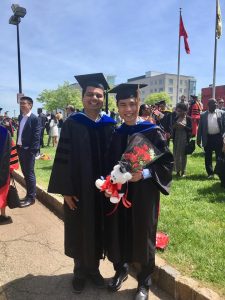
Matt Mitsui became our 7th PhD Graduate of the lab on September 20th! He successfully defended his dissertation, “Adopting a Graphical Perspective in Interactive Information Retrieval Research” in front of a demanding panel of fellow scholars.
Matt Mitsui, right, after defending his dissertation, with Professor Chirag Shah.
Matt’s dissertation demonstrates that task characteristics, user characteristics, and behaviors should be empirically studied as a network of dependencies. It expands empirical work using graphical modeling, which can uniquely capture phenomena such as mediation and conditional independence. His research empirically shows when knowledge about behavior and certain task characteristics can be used to learn about other aspects of the task. Additionally, it shows how task and user characteristics simultaneously affect behavior while potentially affecting each other. Specifically applying path analysis and Bayesian structure learning, results are shown to agree well with past literature and to also extend our understanding of the information seeking process.
Congratulations to Dr. Matni and Dr. Mitsui; we wish you the best of luck in the next chapter of your lives!
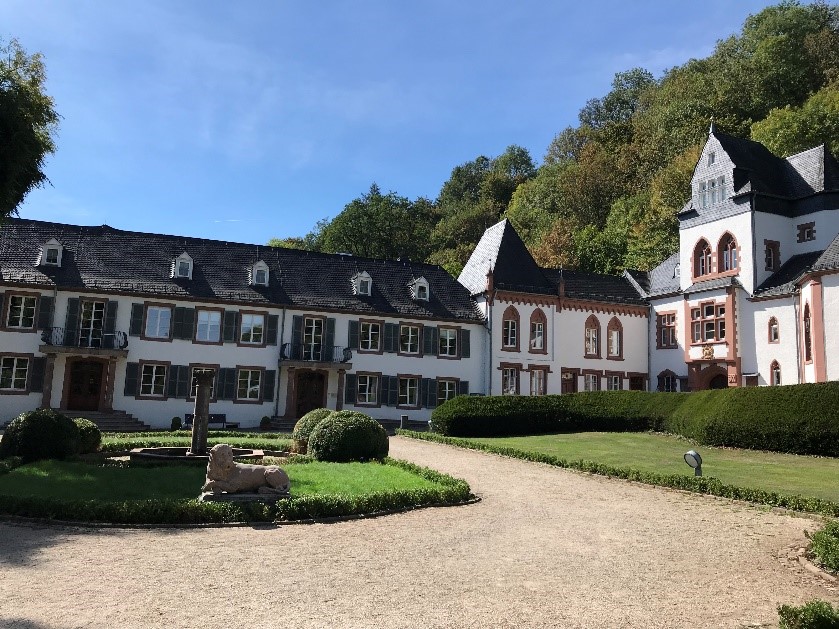
This year, Schloss Dagstuhl – Leibniz Center for Informatics in Saarland, Germany hosted another successful Autumn School for Information Retrieval and Information Foraging (ASIRF). The event took place between September 16-21, 2018. Sponsored by the ACM Special Interest Group on Information Retrieval (SIGIR), German Informatics Society (GI), Center for Informatics Research and Technology (CIRT), and the University of Trier, ASIRF 2018 attracted twenty graduate students with diverse backgrounds from five countries. There were nine lectures given by leading academics in their respective fields. These lectures provided the attendees an opportunity to advance their knowledge in the domains of Information Retrieval (IR), Interactive Information Retrieval (IIR), Human Information Behavior, Collaborative IR, and Computational Social Science. Also, they had ample time to expand their research networks at a remote, serene area in the German countryside.
Schloss Dagstuhl
On Sunday, I arrived at Schloss Dagstuhl after an eighteen-hour-long journey from New York which included a flight from New York to Frankfurt, a scenic train ride from Frankfurt to St. Wendel through the hilly regions of Hesse, Rhineland-Palatinate, and Saarland, a short bus trip in the middle of farms and wineries to Dagstuhl Bahnhofstrasse, and finally a walk to Schloss Dagstuhl. However, the weariness of the journey vanished immediately in the prospect of spending the whole week in a single room on the top floor of a eighteenth-century old manor house. The evening started with a delicious meal and ended with the keynote lecture by Dr. Michael Lay on the evolution of the conceptual data model of dblp Computer Science bibliography system.
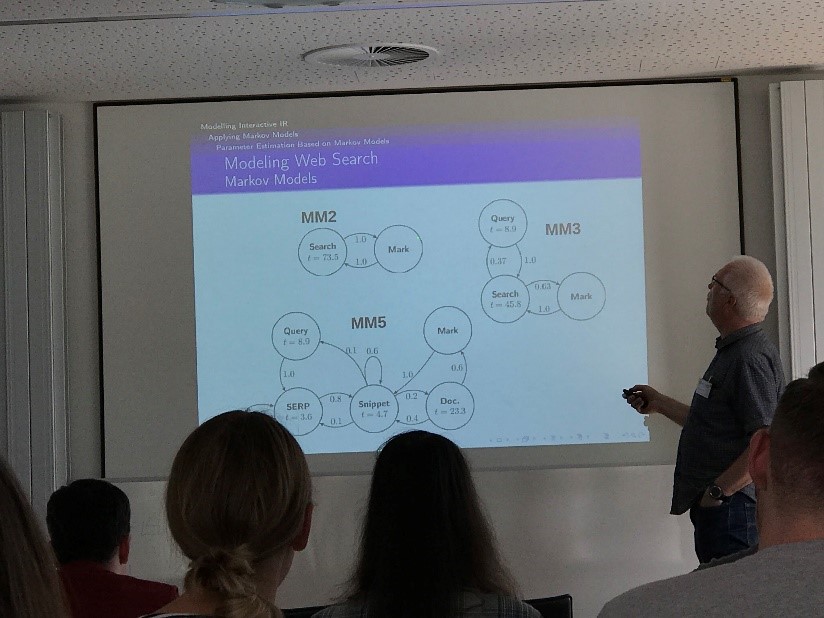
Dr. Fuhr is talking about Morkov models
Throughout the week, leading scholars in the field delivered a range of lectures and presentations that covered a broad spectrum of topics related to information retrieval and information seeking behavior. On Monday, Dr. Ingo Frommholz provided an introduction to IR models – from Vector Space Model to some more advanced information retrieval models. Dr. Ralf Schenkel offered a foundation course on IR systems and efficiency methods of query processing. The lectures on theoretical foundations of system-centric IR were followed up with a comprehensive presentation by Prof. Dr. Norbert Fuhr on techniques for modeling Interactive IR and Information Seeking and Searching Behaviors. He presented an overview of the Probability Ranking Principle for Interactive IR, Markov models, Hidden Markov models, and parameter estimation based on Markov models. He also introduced the participants to the concept of information seeking and searching, some well-known cognitive search models such as Ellis’ behavioral model of information seeking strategies, Bates’ Berrypicking model, Belkin’s ASK model, Ingwersen’s Cognitive model, and user interface design based on cognitive models.
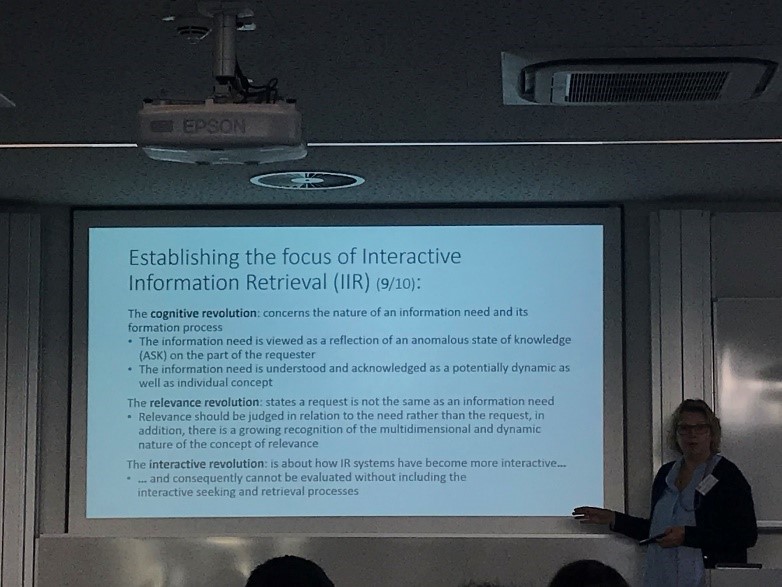
Dr. Borlund is talking about the research on IIR
The next day, Dr. Pia Borlund presented a comprehensive overview of Interactive IR research field starting from how IIR is related to IR and information seeking to IIR evaluation model and simulated task situations. Finally, Dr. Borlund walked us through her process of designing and conducting IIR user studies. Later, Dr. Christa Womser-Hacker provided a thorough introduction to information behavior and various information seeking models including information foraging theory. The following lecture was given by Dr. Andreas Henrich on digital research infrastructures for the humanities and social sciences. Dr. Henrich discussed challenges and opportunities for retrieval systems and specialized databases in support of digitally-enabled research and teaching in the arts and humanities.
Later in the week, Dr. Henning Wachsmuth presented the argumentation analysis and retrieval using natural language processing (NLP). He introduced the key concepts of argument mining, assessment, and retrieval, and highlighted its applications in various domains such as intelligent personal assistants and fact-checking. On a similar note, Dr. Ahmet Aker started off by providing an overview of fake news and online rumors and explaining how these can be detected by using classic machine learning methods such as support vector machines, decision trees, k-nearest neighbor classifier, and deep neural networks (CNN and LSTM). Then, he offered a practical tutorial with case studies on deep learning including a brief overview of programming interfaces like TensorFlow and Keras where we had opportunities to use Keras and apply RNN and LSTM to real research problems.
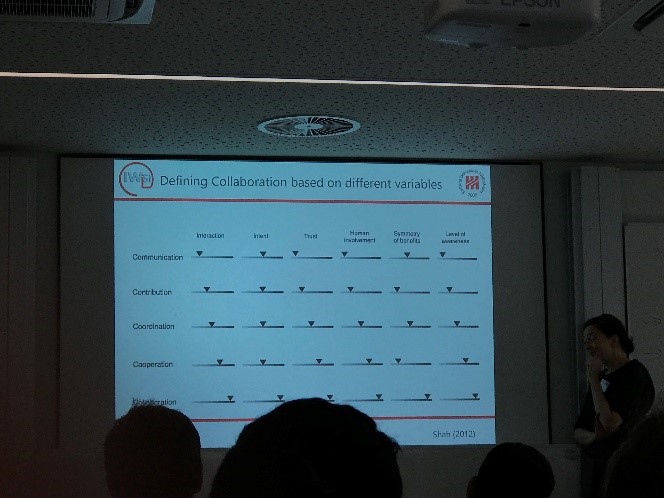
Dr. Elbeshausen is defining collaboration using Dr. Chirag Shah’s framework of CIS
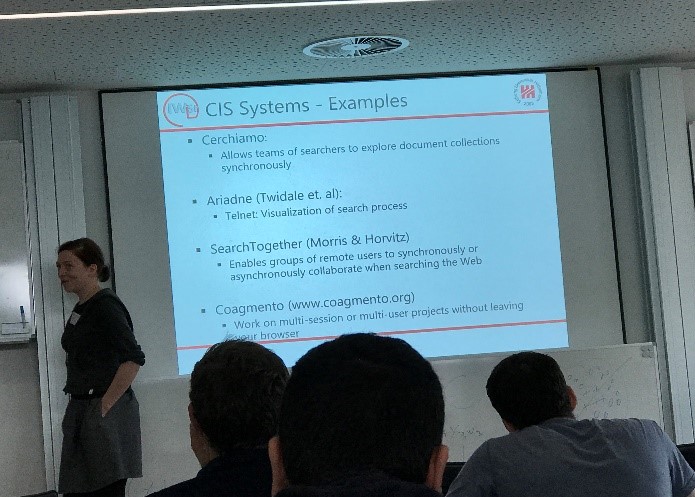
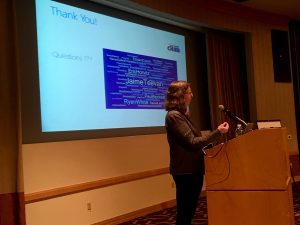
The last tutorial of the ASIRF 2018 was presented by Dr. Stefanie Elbeshausen on Collaborative Information Seeking (CIS). Dr. Elbeshausen introduced the topic with defining collaboration and its characteristics, collaborative browsing and seeking. She also covered some of the prominent CIS systems including our own Coagmento.
Dr. Elbeshausen is describing CIS sytems including Coagmento
Apart from the tutorials, there were also opportunities to have hands-on experiences in applying those learned concepts in practice. The participants were divided into small groups and assigned tasks to propose a new ranking algorithm, design user interface for an IR system or, raise an empirical research question, and then they presented their ideas in front of fellow students. The assignment helped us to apply the concepts and techniques that we had learned about throughout the week. Moreover, all participants had the opportunity to give a presentation of their work.
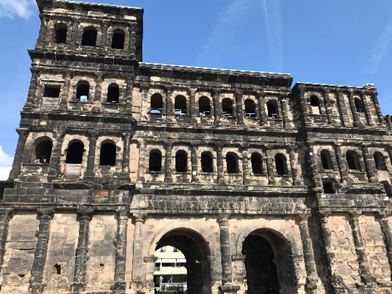
Porta Nigra – Roman architechture in the city of Trier
Other than these scholarly activities, we also enjoyed the cordial hospitality of the Schloss Dagstuhl staff, including randomized seating arrangements during our delicious meals and wine and cheese events at the wine cellar, which facilitated further discussion opportunities among students and faculties. We also had a chance to explore the beautiful area around Schloss Dagstuhl. We enjoyed a hike through the woods to the ruins of the old Dagstuhl castle on top of the hill. We also went to a guided tour of Trier, the oldest city in Germany and birthplace of Karl Marx, followed by a pleasant visit to an old winery to taste some of the best wines from the famous Mosel wine region.
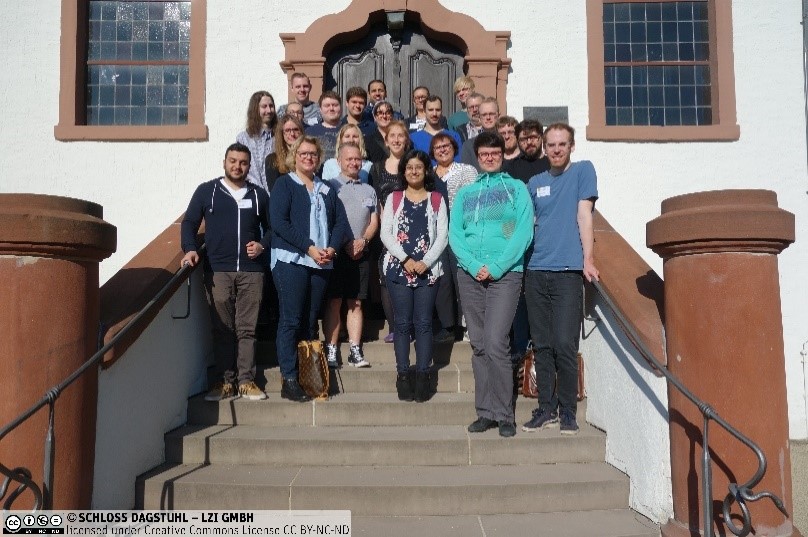
Group photo of the attendees
For me, the Autumn School was a very productive and pleasant experience. It helped me to enhance my knowledge in information seeking and retrieval, establish valuable research connections, and make new friends. My experience would not have been possible without the generous grants from the ACM Special Interest Group on Information Retrieval (SIGIR), and our PhD program at the School of Communication and Information.
Activities included travel, classes, lab meetings and socializing!
Where does one begin to describe the summer of 2018? Chirag summed it up when he said, “We had a fantastic, fun, and productive summer. I think even having lab meetings every week throughout the summer is an achievement. We learned a lot from each other and had fun doing so. InfoSeekers have won awards, presented papers, and traveled to different corners of the world. Even our alumni have done some wonderful things.”
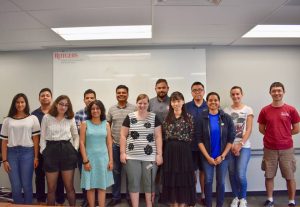
InfoSeekers line up for an end-of-summer group photo.
The following captures just the highlights of InfoSeekers at work and play, keeping things interesting as they moved their studies forward.
Manasa Rath went to summer school in Los Angeles, and her team rated runner-up status for an award for a project for “Summer Methods Course on Computational Social Sciences.” Before attending the course, Manasa had scored full funding for her travels, accommodation and other support. (Only 11 percent of those who apply for this support receive it.) While there, she met other graduate students from the U.S. and Europe who were learning about automated textual analysis. Her team’s project concerned using word embeddings to measure ethnic stereotypes from various news corpora, including NPR (National Public Radio) and The New York Times.
Meanwhile, Souvick Ghosh did a ten-week internship as part of the LEADS-4-NDP (National Digital Platform) Fellowship Program. Each intern in the program worked with different industry partners focusing on data science problems. Vic collaborated with OCLC Research to cluster publisher names using MARC records. (OCLC is the global library cooperative that provides shared technology services; MARC stands for Machine-Readable Catalog and has provided the national standard for the description of items for the digital catalog for libraries since 1971.) In their internship work they attempted to cluster instances of MARC records that contain different information such as the title of a book, the author, the publisher, ISBN number, etc. The idea was to cluster the instances of same publisher entities, exploring different hashing and machine-learning approaches, additionally evaluating the relative importance of various features for classifying entities.
InfoSeekers continued lab meetings throughout the summer.
In other updates, Jiqun Liu and Shawon Sarkar started the recruitment phase for a study on people’s search experience and preferred supports in information seeking, the purpose of which is to improve Web search. So far, four people have completed the study. Recruitment and running the study will likely continue through mid-October.
InfoSeeking Lab Director and all-around inspired leader Chirag Shah did his share of travel this summer including a visit to Ryerson University in Toronto, where he gave a talk about data and algorithmic biases. (See his August 6 blog.) But the real fun was being able to finish his goal of making it to all 50 of the states in the U.S.
Please be sure to scroll all the way down to see the fun capper snapshot!
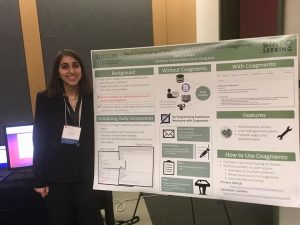
Diana Soltani presenting her summer research on Coagmento with a poster and a demo.Never let it be said that InfoSeekers are anti-social. Lunch out helps punctuate the end of a great summer.Alaska was the final frontier for Chirag’s quest to visit all 50 U.S. states. Here are Chirag and Lori Shah in a kayak in the mountains in White Pass, which is actually in the Canadian Yukon territories if you want to get picky. (Did you know that the kayak comes to us from the native peoples of Alaska, Canada and Greenland?)
By the way, have a wonderful fall semester, InfoSeekers, and a very Happy Birthday to Chirag!
Addressing bias by bringing in diversity and inclusion in search
When it comes to Web search, the Matthew Effect (rich gets richer) applies quite well. Things that show up on the top of a rank list are likely to get clicked more and as they get clicked more, they continue being on the top. Of course, that’s not bad in itself; if there are things relevant to one’s query every time, why not have them show up at the top? But this becomes problematic when objectionable and deceptive items get to the top for some reason.
Think about sensational news. People like them; more specifically, people like clicking on them. When a title of a story says “You won’t believe what NASA is hiding”, most people are naturally enticed to click on it. It doesn’t matter if that story actually has anything substantive or not, but it got clicked, and in many instances, shared. This all probably started by someone searching for ‘NASA’. Or, increasingly, such a story coming up as a paid content (ad) next to a real story. A search system then treats this as a signal of relevance and the next time this story gets even more prominent position, thus starting the vicious cycle of the Matthew Effect. We are victims of our own desire to be curious and wanting to get attention by others!
There are many instances of this and other kinds of intentional and unintentional biases in today’s Web searches, social media, and recommender systems as people try dirty techniques of SEO (search engine optimization), click-bait, and simply wanting to spread rumors and “fake news”. It’s becoming an increasingly frustrating problem for service providers and users, but even more seriously, a threat to our democracy and free speech (and some may even say, free will).
There is no single solution for this. But we have to try all that we can to fight such issues of bias and fairness in Web. For my part, I have been addressing this through the use of collaboration — specifically, bringing in diversity and inclusion in search. For example, in 2007-2008, as a part of my work with Jeremy Pickens and late Gene Golovchinsky at FXPAL, I looked at having people with different backgrounds and skillsets to work together in collaborative search. This was with algorithmic mediation. During 2008-2010, I continued exploring this idea from the user side (people identifying and leveraging different roles). With my doctoral student Roberto Gonzalez-Ibanez, we then worked on identifying opportunities for collaboration in search (2010-2012), so we could start creating synergies instead of biases. In 2013-2014, I worked with Laure Soulier and Lynda Tamine from IRIT in France to bring both the system-side and the user-side together in an attempt to have diverse roles of people while working on search tasks.
While these works were going on with collaboration, I have also been exploring a parallel thread on social information seeking. This is where I studied how communities could come together in creating more synergic solutions, sort of using “wisdom of crowd” idea, rather than relying on any single individual’s ideas and opinions. This thread has been carried out from 2008 to the present day.
Now, we have started a new thread in my lab that is aimed at addressing bias in search in an individual searcher’s setting. It’s not easy. First off, the notions of bias and fairness are not clearly defined, and our own understanding of them keeps evolving. Second, there are several layers of complexity here that involve data as well as algorithms of ranking and organizing information, and it’s not always clear which of these layers are responsible for introducing bias. Third, there is a large amount of personalization in pretty much everything we see and consume on the Web today. Since this layer of personalization is, as the name suggests, personal, it’s hard to peel it off.
Still, I think this issue of bias and fairness in the Web is very important and together with my colleagues and students, I am continuing to invest a lot of efforts on this problem. It’s been more than a decade of working on this problem through many different angles, and I feel like we are just getting started!
SIGIR 2018: Who, What, Where, When, and What Happened?
This year’s ACM SIGIR (Association for Computing Machinery’s Special Interest Group on Information Retrieval) conference took place July 8-12 in Ann Arbor on the beautiful campus of the University of Michigan.
The golden hour on the campus of U. Michigan.SIGIR 2018 logo
The 41stannual conference featured a rich assortment of tutorials, a doctoral consortium, conference keynotes, technical tracks and workshops, many papers, and mealtime special events.
Some of our favorite InfoSeekers attended and had responsibilities. Souvick Ghosh was the new SIGIR Student Liaison for the Americas region. He and Soumik Mandal were also student volunteers. As Student Liaison, Vic’s goal was to welcome the students “in the corners” into the community so that no one is left behind. As Student Affairs Chair Laura Dietz put it, they are to encourage students to “Come, talk to us!”, which is also their motto.
Soumik was responsible for maintaining the smooth operation of a few sessions including “Women in IR,” a session that focused on challenges faced by women in information retrieval, computer science and related research communities.
Matt Mitsui and Jiqun Liu presented a short paper, “How Much is Too Much? Whole Session vs. First Query Behaviors in Task Type Prediction.” And, Chirag Shah’s book on Social Information Seeking: Leveraging the Wisdom of the Crowd (2017) was on display at the Springer table.
Left to right: Souvick Ghosh, Salton Award winner Professor Kal Jarvelin, and Jiqun Liu. (Chirag Shah is photobombing!)
“The conference is a wonderful opportunity to meet researchers whom we cite and read about, and the industry partners. The social events and coffee sessions were perfect to meet our academic inspirations and role models,” Vic said.
Next year: Paris! And, drumroll please, Chirag will be a general co-chair for the SIGIR 2021 conference.
Heartiest congratulations go to Dr. Dongho Choi and Dr. Long Le for completing their PhDs in Information Science and Computer Science, respectively. And equally ecstatic congratulations to Ms. Shawon Sarkar and Mr. Jiho An for completing their Masters in Information degrees.
Shawon Sarkar with Professor Chirag Shah.Dr. Dongho Choi with Professor Chirag Shah.Dr. Long Le with Professor Chirag Shah.InfoSeekers gathered for a reunion lunch around graduation celebrations.
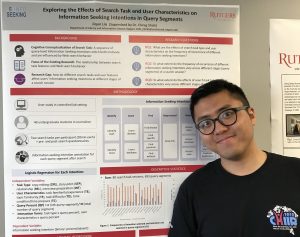
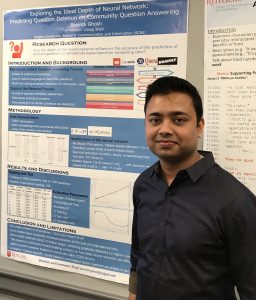
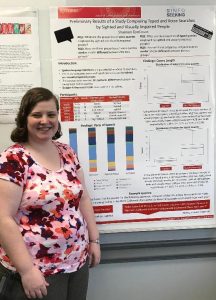
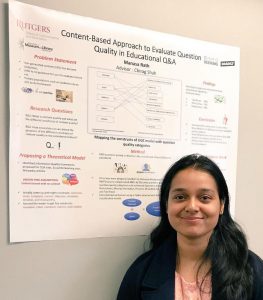
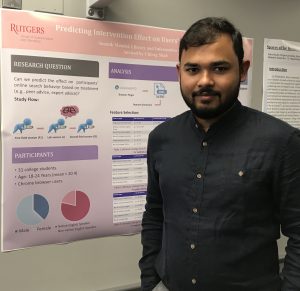
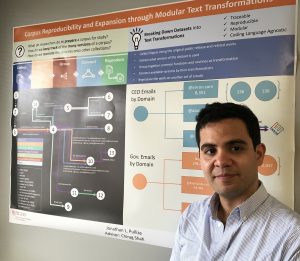
On April 25, as the spring semester was in its intense final days, six InfoSeekers presented practicum posters to their colleagues and Professor Chirag Shah, who had advised them on the projects. Here are representative photos of each doctoral student presenter with the title of their practicum. (Be sure to scroll all the way to the bottom.)
Jiqun Liu presented, “Exploring the Effects of Search Task and User Characteristics on Information Seeking Intentions in Query Segments.”Souvick Ghosh presented, “Exploring the Ideal Depth of Neural Network in Question Deletion Prediction.”Shannon Tomlinson presented, “Preliminary Results of a Study Comparing Typed and Voice Searches by Sighted and Visually Impaired People.”Manasa Rath presented, “Content-Based Approach to Evaluate Question Quality in Educational Q&A.”Soumik Mandal presented, “Predicting Intervention Effect on Users’ Search Behavior.”Jonathan Pulliza presented, “Corpus Reproducibility and Expansion through Modular Text Transformations.”
InfoSeekers Are Key to Success of the Third Annual CHIIR Conference
Three cheers to InfoSeeking Lab Director Chirag Shah and several other InfoSeekers who helped organize and host a successful CHIIR conference.
On March 11, some 130 researchers from 25 countries in North America, Europe and Australia descended on New Brunswick for five days of workshops, presentations, tutorials, networking and fun.
CHIIR stands for the Conference on Human Information Interaction and Retrieval, which is sponsored by the Special Interest Group on Information Retrieval (SIGIR), in cooperation with (SIGCHI). The international conference represents a merger of two successful past events: the Information Interaction in Context (IIiX) conference and the Human Computer Information Retrieval (HCIR) symposium, which have run since 2006 and 2007, respectively.
The events took place at the SC&I building on the College Avenue campus of Rutgers and at The Heldrich Hotel in New Brunswick. This year’s keynote speakers were Pertti Vakkari from Finland’s University of Tampere and Susan Dumais from Microsoft. Dr. Vakkari spoke about “Information Search Processes in Complex Tasks,” focusing on key areas in information retrieval, such as how the effect of information search would depend on task outcome. Dr. Dumais’s talk, entitled, “Better Together: Interdisciplinary Perspective on Information Retrieval,” reflected on her work in Information Retrieval and Human-Computer Interaction and provided some predictions on the future of search on the Web.
The major areas of study discussed at CHIIR 2018 included user-centered aspects of information interaction and information retrieval focusing on aspects of human involvement in search activities, and information seeking and use in context.
InfoSeeking Lab Director Chirag Shah said, “I’m very proud of InfoSeekers for representing our lab at this international conference – not just with their scholarly contributions (papers, posters, demos, doctoral consortium), but also in helping organize this event.”
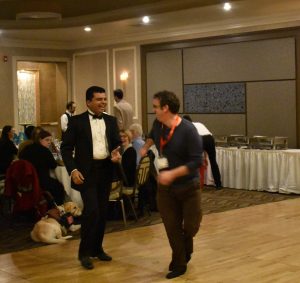
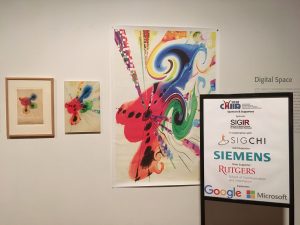
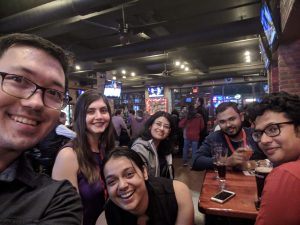
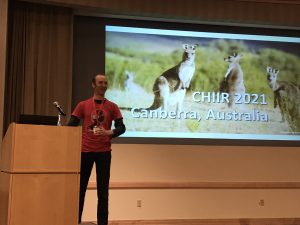
Susan Dumais of Microsoft taking questions following her keynote address.There were 22 full papers, two dozen short papers (posters), five demos, 10 doctoral dissertation proposals, four tutorials, and two workshops.Most attendees participated in sessions on full papers, short papers, demonstrations, and the doctoral consortium.InfoSeekers at the welcome reception at Zimmerli Art Museum. InfoSeekers contributed four full papers, some short papers, a couple of demos, and a doctoral consortium presentation.Nick Belkin, Pertti Vakkari and Souvick Ghosh at the Welcome Reception at the Zimmerli Art Museum on the Rutgers campus, which featured the exhibition “Set in Stone: Lithography in Paris, 1815-1900.”The banquet dinner was held at Ria Mar, a Portuguese restaurant in New Brunswick. A highlight was seeing Chirag warm up the dance floor. (Did you know he’s a trained ballroom dancer?!)This year’s conference was sponsored by Siemens, Rutgers SC&I, Google, and Microsoft.A snap of the student get-together at the Hub City Brewhouse in New Brunswick.CHIIR 2019 will be held in Glasgow, Scotland. Looking forward to 2020, the conference will be in Vancouver, Canada, and in 2021, Canberra, Australia.
Photo credits: Souvick Ghosh, Matt Mitsui, Chirag Shah.
A wedding for which the planning was facilitated by Coagmento.
Coagmento was initially developed by Chirag Shah, in 2007, as a research project for his PhD dissertation. When Dr. Shah brought Coagmento to Rutgers University, it was further developed by his PhD student Roberto Gonzalez-Ibanez, followed by several other undergraduate and graduate students at Rutgers. Over the decade, many iterations of Coagmento have been released in Beta and public versions, as it continues to be tested and used and some bugs worked out. In 2013, Coagmento Collaboratory was released and later that year the first full version, Coagmento 1.0, was released. In 2016, Coagmento 2.0 was released, and later this year Coagmento 3.0 will be released with the aim to be even more user friendly.
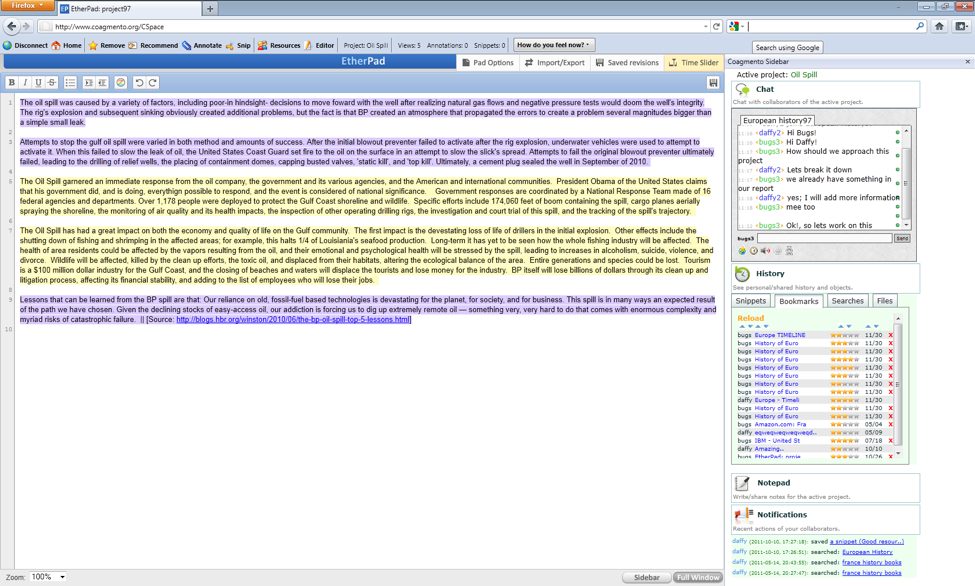
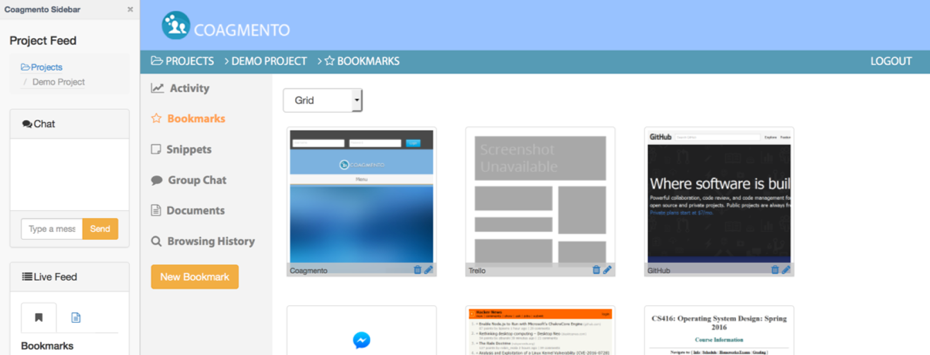
What exactly is Coagmento and what does it do? Coagmento is a Web-based, open-source tool for information seeking that facilitates the collecting of information and collaborating on projects in teams. It helps the user at every step by recording visited Websites, bookmarking pages, and collecting pictures or snippets of text or source information. All along a live chat feature allows team members to confer from remote locations over multiple sessions. At the back-end, Coagmento is comprised of two major components: (1) Node.js, which creates a server-side notification framework and “push notifications,” and (2) is coded in Laravel, a Model-View-Controller PHP framework that supports several SQL databases. Since version 2.0, Coagmento has been available through GitHub as an open-source tool.
Coagmento 1.0 in action.
On the serious side, Coagmento can allow collaborators to work on challenging informational tasks. For example, it could help siblings gather information about their parent’s illness so they can be proactive in making decisions. In a classroom setting, Coagmento has been deployed for dozens of students to up to several hundred to facilitate collaboration. Keeping track of disparate pieces of information means that when the student/researcher sits down to write a report or create a presentation, the information is saved in a workspace where it can be put it together.
Coagmento 2.0 in action.
On the lighter side, Dr. Shah said, “When my wife Lori and I were planning our wedding, we used Coagmento to keep track of places in the North Carolina mountains for location consideration so we could make a decision with all the pieces in front of us.” He continued, “But, it’s come a long way since then as not only a tool but also a platform for supporting and studying individual and collaborative information seeking.”
Here’s a toast to the next ten years as Coagmento continues to evolve in usefulness and application to many of life’s information challenges.
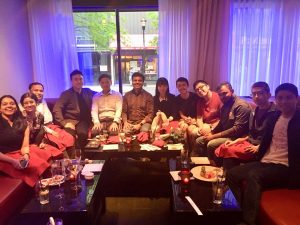
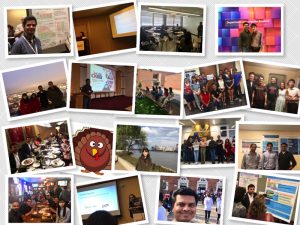
On this, the 18th day of 2018, let’s take one last look at some of the great moments of 2017.
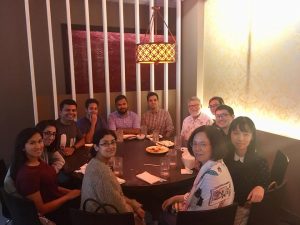
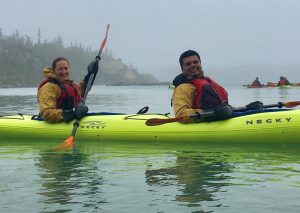
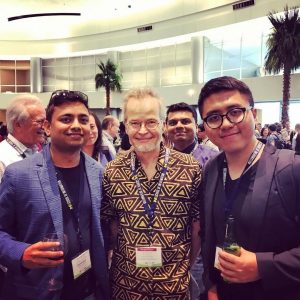
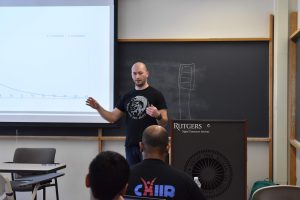
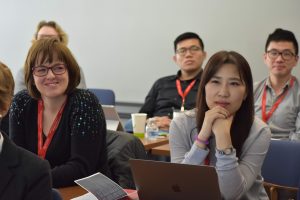
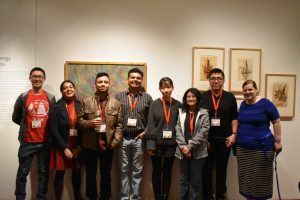
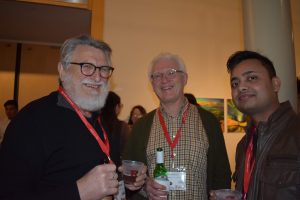
In 2017, InfoSeekers attended classes, did their homework, performed experiments, compiled results, had meetings, collaborated on papers and posters, traveled to conferences, made presentations, and socialized.
Mostly they pushed themselves to do things that haven’t been done before, zeroing in on ways to innovate efficiencies in information science.
Stay tuned for how this A-Team will top that in Twenty-eighteen.


 On this, the 18th day of 2018, let’s take one last look at some of the great moments of 2017.